The work, in the order it had to happen
- Win the vote on a plan. Known: the board had every reason to move on, and continuity was the one thing I could not honestly promise. Unknown: whether a board would keep a vendor whose principal had just passed. The question I asked was what they were buying from us that they could not buy from a bid, and the answer was presence and a bounded answer to the emergency question. Both of those can be written down and measured, so I wrote them down. It produced the vote. It changed the contract from a relationship into an operating agreement.
- Relieve the single point of capacity before touching anything else. Known: one person was doing everything, and the three inherited defects, the stale contracts, the thin board communication, the absence of any system, were the same defect showing up three times. A single person answers the work orders because work orders are loud, and starves everything that is not loud. The question was which fix unblocks the others, and the answer was capacity: a full-time lead with seasonal hands behind him and a wider pool of trades I could call. It changed the account from a job one person carried to an operation.
- Read the contract file line by line against the market. Known: the rates in the file had not moved in years while the cost of doing the work plainly had. A stale contract does not announce itself the way a broken pipe does; you have to go and look. The question was what each category of work actually costs today, and I had an internal number for most of them from the years on the property, so the review was fast rather than exploratory. It produced the contracts rewritten and revalued to market. It changed the economics of the account from something inherited to something priced.
- Restructure the deal so defined work has its own line. Known: a flat monthly retainer had been absorbing project work it was never built to cover, silently, for years. The question was what the retainer should cover and what should be scoped and billed as a defined service. It produced a monthly retainer with annual services on top of it. It changed the conversation with the board from a fee they could not see into to a schedule of work they could read.
- Split the queues. Known: routine work and emergencies were competing for one crew. The question was whether they are the same kind of problem, and they are not. The table below is the operating model, drawn as the two systems it became.
| The two systems | Preventive maintenance | Critical response |
|---|---|---|
| The problem it solves | Predictable wear, on a calendar, ahead of the work order | A call that cannot wait |
| What sets its pace | The maintenance calendar, by system | The severity window, set by tier at intake |
| Who does it | The routine crew and the scheduled trades | A crew held in reserve, never pulled from a routine job |
| What it must never do | Stop for an emergency: a half-finished job is an exposed unit and a second trip | Wait in the routine queue behind a job that cannot cleanly stop |
| What it is sized to | Volume: tickets, hours per ticket, hours available | The window minus the drive, which no staffing choice shortens |
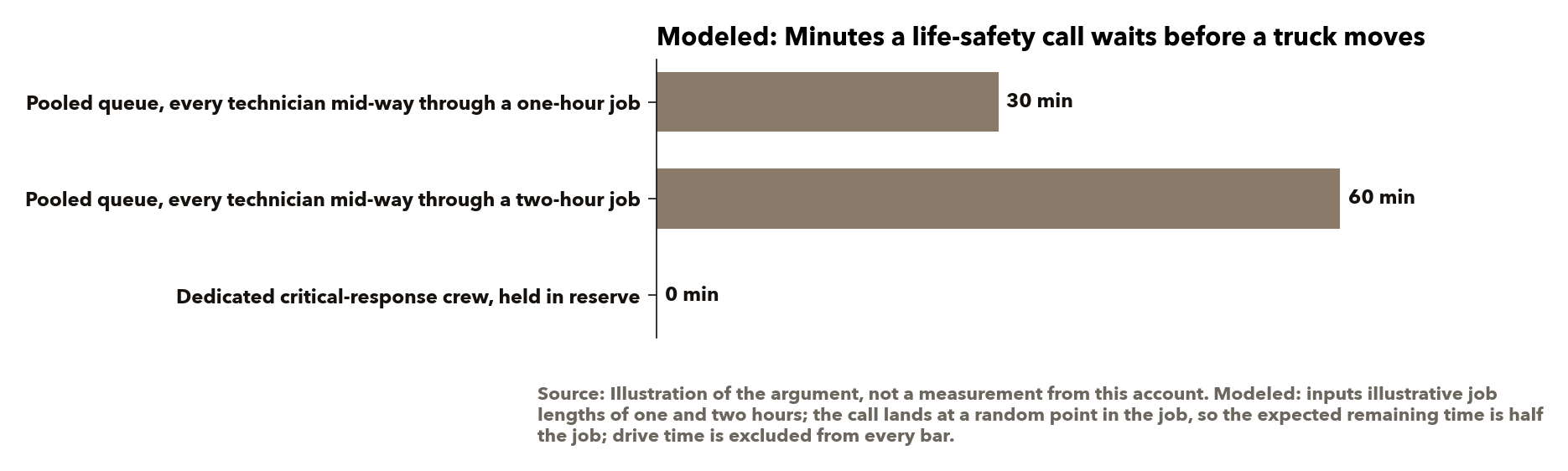
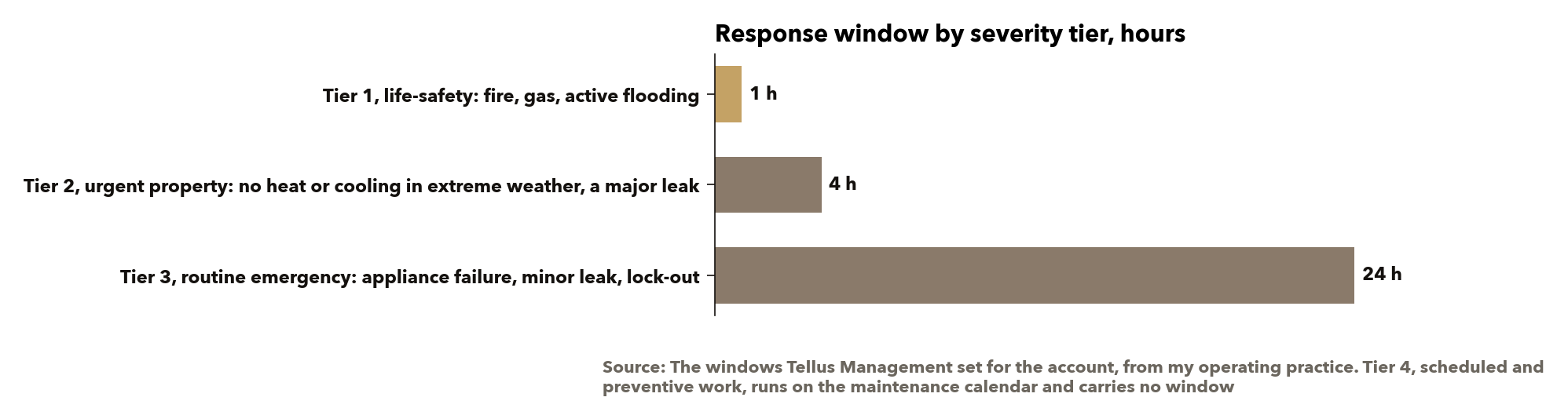
The argument for the second crew is arithmetic, not instinct. If a life-safety call arrives while every routine technician is part way through a job that cannot cleanly stop, the call waits for the first one to finish before a single mile is driven. The figure below draws that wait for two illustrative job lengths. Set it beside the life-safety window on the severity strip and the design decides itself: a pooled queue can spend the entire window waiting for a job to end, before the drive, on a call that has no window to spare.
- Write the windows down and give the dispatcher a rule. Known: a severity table is only as good as the call a dispatcher makes under pressure with half the information. The question was what three questions sort a call correctly at intake, and the answer was: is anyone in immediate danger, is water or gas actively flowing, and is the unit uninhabitable as a result. Any yes is Tier 1. Any ambiguity goes up a tier, never down. It produced the strip below and the intake rule in the section on what we installed. It changed the emergency from a judgment call into a procedure.
- Close the loop, and protect the person who errs on the safe side. Known: a tiering system with no feedback drifts, because dispatchers learn shortcuts. Every Tier 1 call and every missed window got a one-line review and, where warranted, a standing change to the rule, the crew or the intake questions. That catches a call sorted too high. It does not catch one sorted too low, because a call wrongly sent to the routine tier runs against the routine window and never breaches it, so those were pulled on their own. The rule that kept the safe side alive is in the intake box below.
- Put the board on a cadence, and re-make the case for the reserve crew every year. Known: a reserve crew sits idle most weeks, and a board that funded it once will eventually ask why it is paying for capacity it never sees used. The question was what the board should see, how often, and what triggers a call outside the cadence. The table below is the answer; Attachment B is the pack in full.
| What the board saw | When | What triggered a call outside the cadence |
|---|---|---|
| Every emergency call, its tier, window and response | Weekly | A life-safety call: same-day notice to the community manager |
| Preventive work against the calendar, with anything deferred and why | Monthly | A missed window on the top two tiers: notice with the review attached |
| Spend against budget, including what the reserve crew cost and rolled on | Monthly | A budget variance past the agreed threshold: direct notice, not held for the month |
| The year's calls by tier, the crew's utilization, the reserve crew re-justified on the year's volume | Annually | A standing-rule change made under our own authority: logged in the next weekly report |
- Run it. From the vote in 2015 to the end of the term in 2022, I ran the account directly with a project lead beside me and carried everything else myself. The design held through 2020, the year every vendor in the country had to rethink how a crew enters an occupied home, because the emergency crew and the routine calendar could be adjusted separately.
What I brought the board was not a lower number. It was a design for who shows up at two in the morning, and a promise they could hold me to.
What it produced
The contract stayed with the son. That is the result, and the strip below is the term it bought: a vote, a run of years, an end on the calendar rather than on a crisis. The decades under my father's company came before this strip, and the point of the design was that they did not have to be the reason the board said yes.
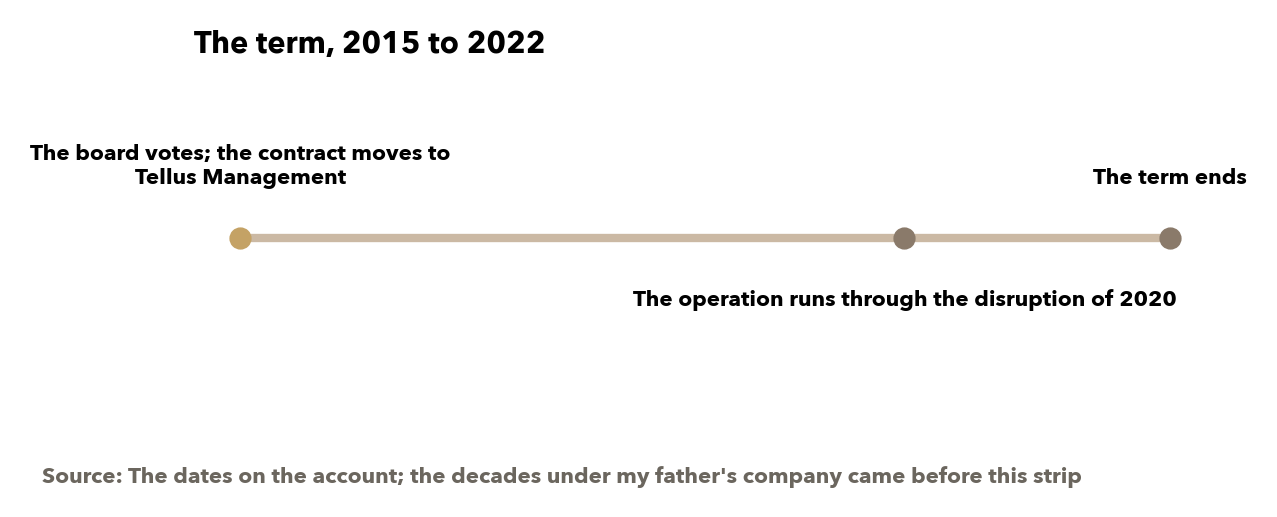
What the board got was a vendor it could read: every emergency call on a weekly report with its tier and its response, every deferred item with a reason, and the case for the reserve crew made again each year on that year's calls. What I got was a maintenance account that ran as an operation rather than as a favor, priced at market, with project work on its own line, and one person beside me instead of a company's worth of overhead for a contract that did not need it.
I will not print response times from memory; a figure without its basis is not a fact. The design does not need them to be checked. It is a mechanical argument: a job that cannot cleanly stop plus a drive that cannot be shortened bounds what a single queue can promise, and the reserve crew removes the only term of that sum a vendor controls.
What we kept, replaced and installed
We kept what the years had built: the crew's knowledge of the property and the trades who had done good work for it. Everything else in the operation we either replaced or built, because the prior operation was my father's, it was sized to a smaller relationship at the start, and it had never been resized.
On the process that mattered most, the queue: my father put it in, one crew handling whatever came, because that is how a small trusted vendor works and for a long time it worked. The fault in the logic was the assumption that a priority rule is enough to protect an emergency inside a shared queue, and it is not, because the routine job in progress cannot cleanly stop and the drive cannot be shortened. It had to change at the vote because the vote was the one moment the board was looking at the design rather than at the relationship.
The intake rule
Three questions, asked in order, before a tier is assigned.
| Question | If yes |
|---|---|
| Is anyone in immediate danger? | Tier 1. Dispatch the reserve crew now. |
| Is water or gas actively flowing? | Tier 1. |
| Is the unit uninhabitable as a result? | Tier 1. |
If all three are no, the dispatcher sorts between the urgent and routine tiers on the examples in the manual. If the dispatcher cannot tell which, the call goes up a tier, never down, and nobody is ever asked to justify the cost of having done so.
In full, what we found and what we did with it:
| What we found | What we did | Why it had to change now | |
|---|---|---|---|
| Staffing | One full-time employee carrying the whole account | One full-time lead plus seasonal hands, and a wider trade pool | Every other inherited defect was this one, starved of attention |
| Contracts | Rates that had not moved in years, well under market | Rewritten and revalued to market, line by line | The vote was the one moment repricing read as honest rather than opportunistic |
| The deal | A flat monthly retainer absorbing project work silently | The retainer, with annual services on their own line | A board cannot approve what it cannot see; a flat fee hides the work |
| The queue | One crew, one queue, emergencies triaged by priority | Two systems: a calendar for routine work, a reserve crew and severity windows for emergencies | The design had to be the pitch |
| Systems | None | Basic tracking for tickets and the calendar, and a reporting cadence | You cannot report what you do not record |
| Reporting | The work got done and the board heard about it when something went wrong | Weekly, monthly and annual reports with named triggers for anything outside them | Presence has to be visible on paper when the person who provided it is gone |
What it cost to hold the line, and what I would watch
The reserve crew cost idle capacity most weeks, which is money a single-queue operation never spends, and I had to make that case to a board once a year on the year's actual calls rather than ask them to take the original argument on faith. Pitching an operating design instead of continuity meant committing myself to run the account personally for the length of the term with a single lead, rather than building a team fast and stepping back, because the fix was sized to what the property needed and not to what would have grown my company fastest. Repricing the contracts at the moment of the vote meant asking the board for market rates in the same breath as asking for its trust, which is the hardest sentence in this report to have said out loud.
There is a lesson on the other side of it that I have had to learn once more since. The instinct this account rewarded, add capacity, add process, add commercial structure, is right for an operation that inherits real complexity and wrong for one that does not. A later property-management engagement of mine was built the opposite way, simple fees and almost no structure, because that portfolio had inherited almost nothing that needed structure. The rule is to size the structure to what you actually took on, not to the playbook that worked last time.
What I would watch, in a maintenance operation or in any business where a person has been quietly carrying what a system should:
- The intake, not the table. The severity windows are only as good as the three questions asked when the phone rings. Review the calls sorted low that later escalated; nobody else will.
- The safe-side rule, in the quiet months. The first time a supervisor asks why the reserve crew rolled on a lock-out, the default-up habit begins to die. Say out loud, in writing, that erring up is never held against anyone.
- The reserve crew's annual case. Idle capacity is the easiest line to cut and the most expensive one to have cut. Re-make the argument on the year's actual calls.
- The contract file, on a clock. Rates drift under market silently. Review them on a cadence rather than at renewal, when it is too late to do it gracefully.
- The single point of capacity. When one person carries an account, the defects you can see are all the same defect. Fix capacity first and the rest becomes possible.
- The structure, sized to what you inherited. Add what the operation needs. Adding more because it worked last time is the same mistake in the other direction, and it looks like diligence.
I worked that property as a kid. Keeping its contract was the work I am proudest of at Tellus, and not because it was the largest account. It was the one where the design had to be good enough that the board did not need to remember my father to say yes.
The result, in short
The contract stayed with the son. Tellus Management ran it seven years, 2015 to 2022, through 2020, with one project lead beside me. The board got a vendor it could read: every emergency call on a weekly report with its tier and its response, every deferred item with a reason, and the case for the reserve crew made again each year on that year's calls. I will not print response times from memory; the design does not need them to be checked, because a job that cannot cleanly stop plus a drive that cannot be shortened bounds what a single queue can promise, and the reserve crew removes the only term of that sum a vendor controls.
A slice of the project list
A few related projects.
- A property management launch: fee design and controls, Phoenix (2023 to present)
- Modular housing fabrication center: operating model, Arizona (2026)
- Sublime Medical: fractional COO, a cosmetic medical group billing and coding fix (2015)
- Greensleeves Steakhouse: co-owner and operator, Redlands (2016 to 2022)